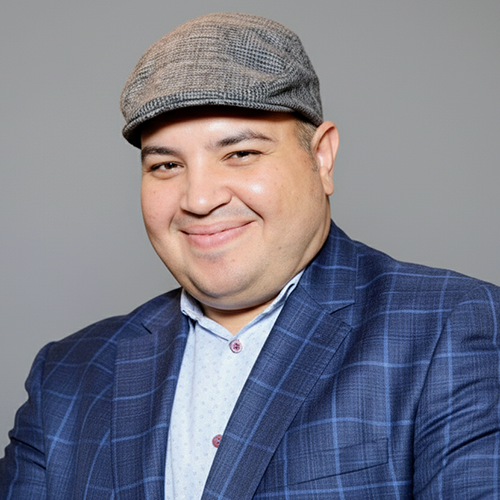
Mohamed ElGohary is a digital strategist and senior international programs leader with over 15 years of experience at the intersection of human rights, technology, and independent media.
A biomedical engineer by training, Mohamed began his career by building a rigorous foundation in systems analysis and quality assurance. He leverages this analytical, “systems thinking” approach to architect and scale large, multicultural networks.
As the former Regional Engagement and Projects Manager at IFEX and a long-standing leader at Global Voices, he excels at leading global, cross-cultural teams, driving digital rights advocacy, and directing complex, donor-funded initiatives across the MENA region and beyond. He serves as a critical strategic bridge, translating data-driven insights into compelling narratives to amplify voices and protect civic space.
Strategic Services Developer
Global Voices
February 2026 – Present
Directing revenue-generating projects and expanding the organisation's global services arm.
Mentor & Capacity Builder
Sudan Wikimedia Usergroup
October 2025 – April 2026
Designing targeted workshops and mentoring grassroots communities to achieve long-term operational goals.
Regional Engagement & Projects Manager - MENA
IFEX
January 2022 – May 2025
Championed digital rights, built resilient cross-border networks, and drove high-level regional advocacy initiatives.
Strategic Governance Lead
February 2026 – Present
MADR Digital Rights Alliance
Spearheading the development of a comprehensive governance structure and facilitating international stakeholder consultations.
Official Representative & Project Leader
September 2025 – January 2026
Anmat
Led operational execution, drove media analysis content strategy, and managed external project handovers.
Project & Community Manager - Lingua
October 2011 – December 2021
Global Voices
Managed cross-cultural community projects and sustained long-term digital translation networks.
With over 20 years of experience at the intersection of human rights, technology, and independent media, I leverage a “systems thinking” approach—rooted in my biomedical engineering background—to build and scale global networks.
Having held senior leadership roles at IFEX and Global Voices, I specialise in bridging the gap between grassroots realities and international strategic objectives, transforming complex regional challenges into measurable, mission-driven impact.
How can I help
Services
Strategic Governance & Structural Design.
Designing robust governance frameworks and operational architectures to align your organisational foundations with your strategic vision.
Mentorship & Capacity Building.
Delivering targeted capacity-building and mentorship programs to empower civil society actors and foster the next generation of regional leaders.
Project Management & Revenue Generation
Providing end-to-end project lifecycle management and architecting scalable workflows to build sustainable, revenue-generating service models.
Media Analysis & Advocacy Strategy.
Translating complex data into compelling narratives and orchestrating cross-border coalitions to launch high-impact regional advocacy campaigns.
Technical Localisation & Digital Translation.
Scaling digital translation networks and providing culturally-aware technical localisation to ensure your digital rights frameworks resonate authentically with regional audiences.
Ten Years on Global Voices: My First Translation and Other Reflections
I can’t believe it’s been 10 years already. I joined Global Voices as an Arabic translator in February 2009. Back then, I was a bilingual blogger, writing about Egyptian affairs as well as web2.0. Still, as a student, though with a part-time online job, I had enough time on my hands to contribute as a translator. At that time, I didn’t have much translation experience; I only read a lot in both languages. My editor who welcomed me to Global Voices was Yazan Badran, probably the first real interaction with a Syrian. I learned a lot from Yazan, linguistically and also how to accept changes to my writing.
My first translation was about Gaza. Palestine, to me, before Global Voices was something I only read about in mainstream media, and you will never get to know the details about conflicts from mainstream media. They are only shortened to numbers. Through Global Voices, I learned that every conflict has a sea of people, everyone has their own life, memories, happiness and pain, and you may or may not be able to know how they felt, even for a third culture kid like me.
Global Voices assured what I thought as the need for networking in the MENA region, expanding from Egypt. After I began blogging in 2006, I spent a big portion of my time networking Egyptian bloggers, till they reached tens of thousand of bloggers. But when I joined Global Voices, I discovered something among Egyptians that we share with our fellow Americans (on average): We don’t know anything about the rest of the world. Even among intellectuals, it is hard to know someone who follows Sudanese affairs, Syria, or Mauritania. Stereotypes about the Gulf and their petrol preventing us from networking with activists there. While the most successful organization is the Arab Interior Ministries council, organized against Arab activists.
Global Voices community, a very diverse community with all kinds of backgrounds across the whole world, assured my views above about the importance of communication, collaboration, and exchange, and not to stay away in silence. I wish all the power to the Global Voices community to be able to make the world a better place. I would like to thank every GVer I met, for every time that happened, I learned something new, and this is something invaluable to me.
Get to Know Mohamed ElGohary, Multitasking Global Voices Contributor
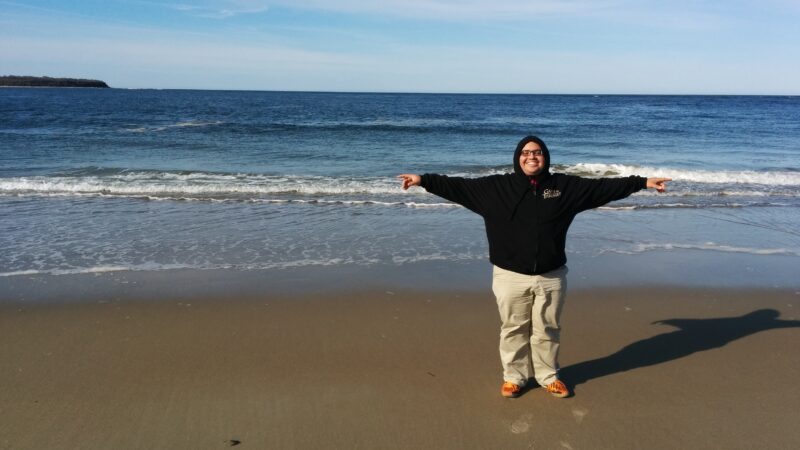
Gohary at Crane Beach, Essex, Massachusetts. Crane Beach. April 20, 2014 (used with his permission).
Global Voices is celebrating 10 years, and as part of the celebrations, we are presenting a series of interviews to introduce some of the contributors who make Global Voices great. In this instalment, we get to know the busy Mohamed ElGohary, Global Voices board member, Lingua coordinator, Advocacy author, Arabic Lingua editor, Web 2.0 preacher and blogger.
Global Voices (GV): How and when did you learn about Global Voices?
Mohamed ElGohary (MG): I began to check out Global Voices as Eman AbdelRahman began contributing and sharing GV posts, as well as asking me if I wanted to contribute. Back then, it was just a year since I began blogging, and partially, I didn’t think I was capable enough to write in English. At the same time, GV began to mention blog posts I wrote, as I was active then in covering court sessions where policemen were tried for human rights violations, blogging under the nickname IRC President.
In February 2009 I joined GV as a volunteer translator from English to Arabic, afterwards I became author and Arabic Lingua editor. In 2011, during the Arab Bloggers meeting in October 2011, I was offered the job as a Lingua Coordinator, after I left my post at AlMasry AlYoum newspaper, where I used to work as a Social Media Consultant.
GV: What are your specific tasks as coordinator for Lingua, Global Voices volunteer translation project?
MG: The role of the Lingua Coordinator is a large set of small tasks. Community management, to ensure the spirit of motivation, cohesion and sharing of information, across Lingua Editors as well as Lingua Community. Tracking stats of different Lingua sites, as well as social media networks. Assisting Lingua Editors and the Community in tracking their own stats, setting up new sites. Helping Lingua Editors identify the best ways to maximise the impact of Lingua. Arranging regular Lingua Editors meetings and addressing any issues that arise with editors that I can help with.
GV: And as the contractors’ representative to the board?
MG: As a staff representative, and the definition of staff here is all Lingua and Regional editors, as well as the core staff, I primarily communicate closely with them, tackling any challenges that might arise either within the volunteer community or staff with other staff, and giving feedback on the short and/or long term depending on what I’m working on. So if anyone in the community has any questions or challenges, please contact me in any way you like: e-mail, Facebook, Twitter, or Skype at ircpresident.
GV: What’s your day job outside of GV?
MG: I contribute most of my time to GV. Before GV, I switched careers from telecommunications, as I majored in Biomedical Engineering, to social media. After joining GV Staff, I co-founded a startup called The Workshops, where I manage technical issues like web administration.
GV: How familiar are you with web tools and how much of it is because you are a GV member?
MG: I spent most of the year 2008 blogging about Web 2.0 in Arabic, writing tutorials on how to use Internet tools targeting Egyptian and Arab activists. I gave many workshops focusing on Web 2.0 use for digital and labour activists, teachers, and journalists. Arabic Lingua gave me the first playground to exercise social media on a professional level. It was also the main reason I got my job at AlMasry AlYoum.
GV: How do you manage to stay up-to-date with all the Lingua communities?
MG: By keeping up to date with Lingua Editors. I think the larger email groups are getting less functional as a community-to-community communication platform, compared to sub-community groups where Lingua Editors are more knowledgeable about their own communities. So, via the Lingua Editors Google group and the monthly meetings, I think I’m staying up to date with the Lingua communities. I’m also in several Lingua Google groups, using Google Translate to follow the general idea of conversations happening.
GV: As an Egyptian citizen based in Egypt, what was January 25, 2011, the date of the Egyptian revolution, like for you?
MG: Right now that’s a very tough question to answer. Before the 25th I was certain that a revolution was going to happen, though maybe after 20, 30 or maybe 50 years. I was hoping to witness it, but I think it happened too fast, though not too soon. I joined the marches in the 28th, when the most clashes during the 18 days happened, and afterwards Images of what happened never leave my mind.
But now, with the extreme politicisation between two groups that are both, in my opinion, responsible for the deterioration of economic and civil liberties in states, it is hard to see the revolution without a broken heart, as secular activists opposed to both military and religious fascism are either dead, jailed or out of the country.
The 25th of January is still a victory to me, whatever happened. As Mubarak is now in jail, the military personnel’s idiocy is exposed. The short term will be a miserable time, but I think in the long term things will get better, although with a very high price in blood.
GV: Anything else you’d like to add?
MG: I want to add that, as a board member, I invite all the Global Voices community to contact me, Aparna Ray, and Jillian York, with any questions, consultations, or comments. We are here for you, and we represent you. Thank you for reading!
In October 2012, I joined my very dear friend Rasha Hassan in creating a startup based on our shared dream of contributing to rebuilding the Egypt we hoped to see after the 25th of January. We shared the common passion for stuff like blogging, music, and many other little joys. We believed that education is key to the welfare of fellow Egyptians. “The Workshops” came to life. The goal was transferring skills, as our current educational system is, simply put, a waste of time.
This may not be the first time I worked in a company from its start, but it is the first time I have been involved in starting one. To share ownership and responsibility. Responsibility, when you invest your own hard-earned money, changes the whole perspective in which you see life. A whole new experience you can’t gain otherwise. Mistakes cost you money and give you experience.
I must say that I was privileged to invest in a startup at such a young age of 25 and privileged to learn until this moment, where all of us, the founders, are no longer able to contribute to this project.
So, after years of facing and bypassing challenges, agreements and disagreements, losses and gains, Al Maqarr, who is a long-time business friend of ours, has acquired “The Workshops”. AlMaqarr has been one of the leading coworking spaces in Egypt since 2012. It manages a solid, diversified community of innovation and collaboration between startups, student organisations, social initiatives, and freelancers. I’m happy that the project will be in their good hands. Wishing you guys all the luck.
Digital strategist and senior international programs leader
Please use the form to request a preliminary consultation. Providing these details helps me understand your context and ensures our initial conversation is focused, strategic, and valuable to your specific goals.